Tyrone D’Lisle, Australian Green, Co-founder & Social Media Lead WePlanet Australia, April '26

Meet the australian green who went from being a supporter of 100% renewables to a nuclear advocate
In a country where nuclear remains taboo, former Greens politician Tyrone D’Lisle has become a bold pro-nuclear voice, bringing environmental conviction, political experience, and scientific curiosity to Australia’s energy debate as co-founder and social media lead of WePlanet Australia.
D’Lisle said he entered politics, joining the Queensland Greens party in 2012 out of a desire to make the world a better place. Specifically, D’Lisle was moved by the poor treatment of asylum seekers and refugees in Australia. As a wealthy country with lots to offer, D’Lisle thought there were no excuses for pushing refugees away, although the policy of the major political parties.
While he had always maintained a curiosity about nuclear energy, D’Lisle was largely informed by the anti-nuclear consciousness in Australia. With little personal knowledge at the time, D’Lisle deferred his position on nuclear to senior members of the Greens party.
When he ran for office in the House of Representatives as a Greens candidate against Peter Dutton in 2013, D’Lisle adopted a 100% renewables platform, without understanding the full complexity of what 100% renewables meant.
Once tentatively supportive of a 100% renewable philosophy, D’Lisle conducted individual research and found the massive amounts of land and materials needed for such a grid. He found nuclear to be smaller in terms of materials and land use, fitting in with all of his values as an environmentalist, but still felt uncomfortable speaking about nuclear, because it was taboo within his Green political tribe.
A TED talk from Michael Shellenberger detailing how environmentalists in the US had grown to support nuclear energy was a turning point for D’Lisle. The talk explored the faults of renewables and the hypocrisy of environmentalists shutting down nuclear plants, to be replaced by fossil fuels.
“This seems just outrageous that we would be so anti-nuclear, that we would sacrifice climate action. He pointed out some of the challenges around wind and solar to do with land and resources and and also making them work in the broader grid,” D’Lisle said. “I finally felt like, ‘Oh, I have support. I have other people in my political tribe who feel that nuclear energy is something that is worth pursuing.”
As a nuclear advocate, D’Lisle said he is unique in coming from a strong Greens background. This background gave him the ability to talk to and connect with environmentally conscious and left-wing people who may have otherwise been more skeptical of nuclear. Additionally, as a social media manager with WePlanet, he has the capacity to take complex ideas and concepts and communicate them in a way that the average person can understand.
D’Lisle was among a group of young Australian Greens challenging the party’s positions on vaccines, urban planning, and ultimately nuclear energy. Progress on nuclear has been accomplished in the last 15 years, D’Lisle said, but some of the older people in the party from a hippie left-wing culture still need to be convinced.
Several other young Greens were skeptical of the Green party position pushing to close the Lucas Heights Research Reactor in Sydney, the primary source of nuclear medicine for Australia, and a source of significant material science research. D’Lisle and others pushed for a more sensible nuclear policy.
“As I dug deeper into the climate, into the science of climate change, and just gained more general awareness about the world and how it operates, I just realized the scale of the challenge was a lot bigger than I had originally anticipated,” D’Lisle said. “I discovered people who were aligned with me politically, who were also advocating for nuclear, and I was just like, ‘okay, I'm not alone. I can do this.’”
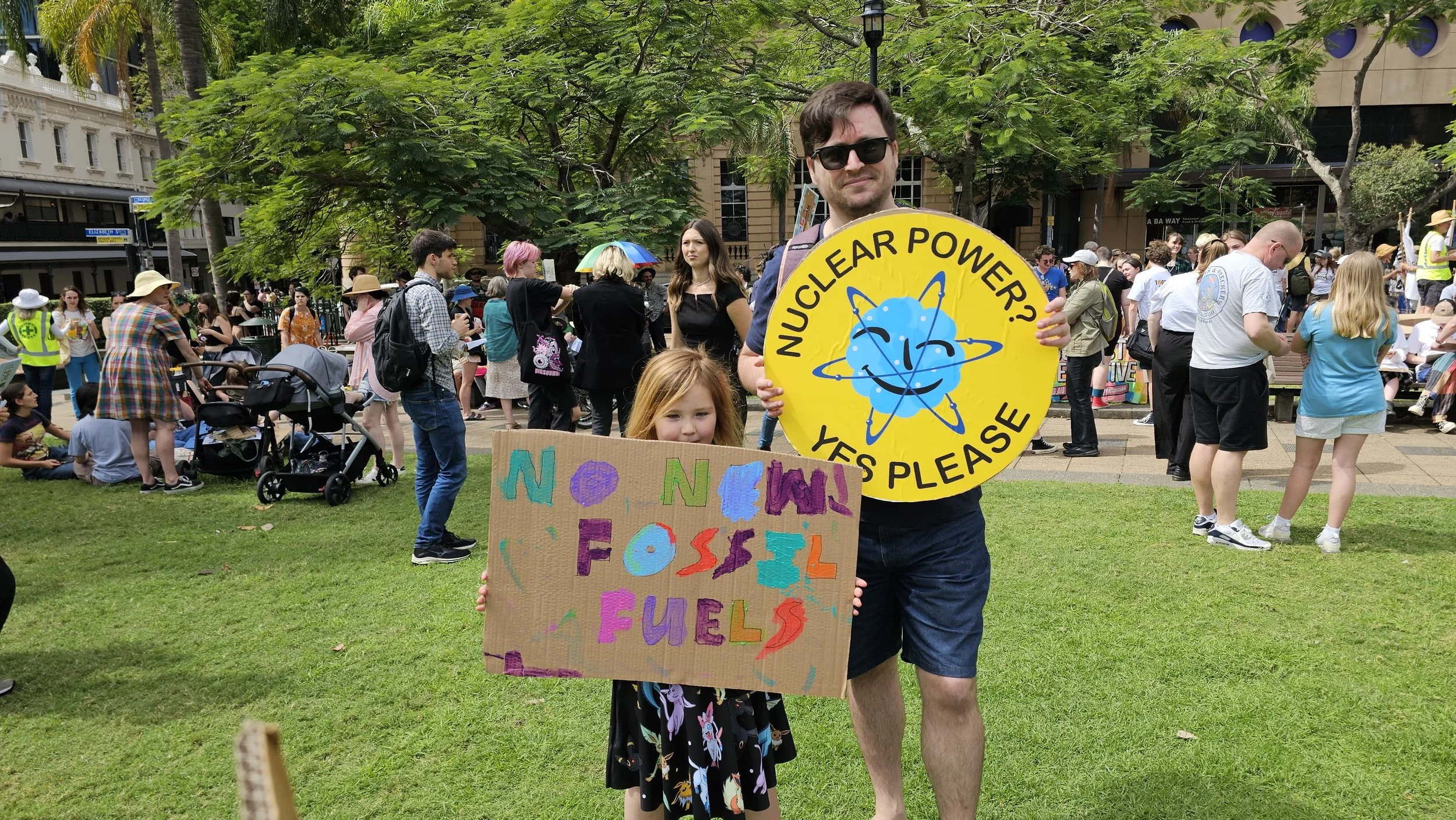
D’Lisle at a climate protest with his daughter holding a “Nuclear Power? Yes Please” sign.
According to D’Lisle, the Greens party has become more open to nuclear, but gatekeepers at senior levels remain with deep ties to the anti-nuclear movement. Elected Greens representatives hesitate to discuss nuclear because they fear repercussions and losing votes. Despite this, D’Lisle said that recent polling shows Green voters are open to nuclear energy in Australia.
In 2021, D’Lisle became the spokesperson for a “little renegade” group of Greens members supportive of nuclear energy. Through his advocacy, he began collaborating with other European pro-nuclear Greens from Finland, Sweden, and beyond, who formed WePlanet in 2022, hiring D’Lisle as the social media manager.
D’Lisle, a former social media manager for a kitchenware company, uses his skills to advance WePlanet’s mission of addressing the twin environmental crises of climate change and biodiversity loss while battling global poverty and inequality. Increasingly, video work has become the dominant media on social media, and WePlanet is investing in nuclear-related videos.
In the most recent election, nuclear energy became a deeply polarizing topic between the Conservative opposition and the Labor government. While D’Lisle said work is needed to rebuild support for nuclear energy, he is optimistic the country will eventually overturn its ban on nuclear energy.
“People kind of fell in line with the party that they were intending to vote for, and overwhelmingly, that was the Labor party that won a significant electoral victory. But right before the election, just a couple of months before the election, nuclear was at its highest support - 55% in support of nuclear energy being built in Australia,” D’Lisle said. “So what that shows us is that people are open to it, but if it becomes a partisan issue, people will take sides with their preferred political party.”
D’Lisle added that the results show how anti-nuclear campaigns by groups like Greenpeace or the renewables lobby can sway public opinion and votes.
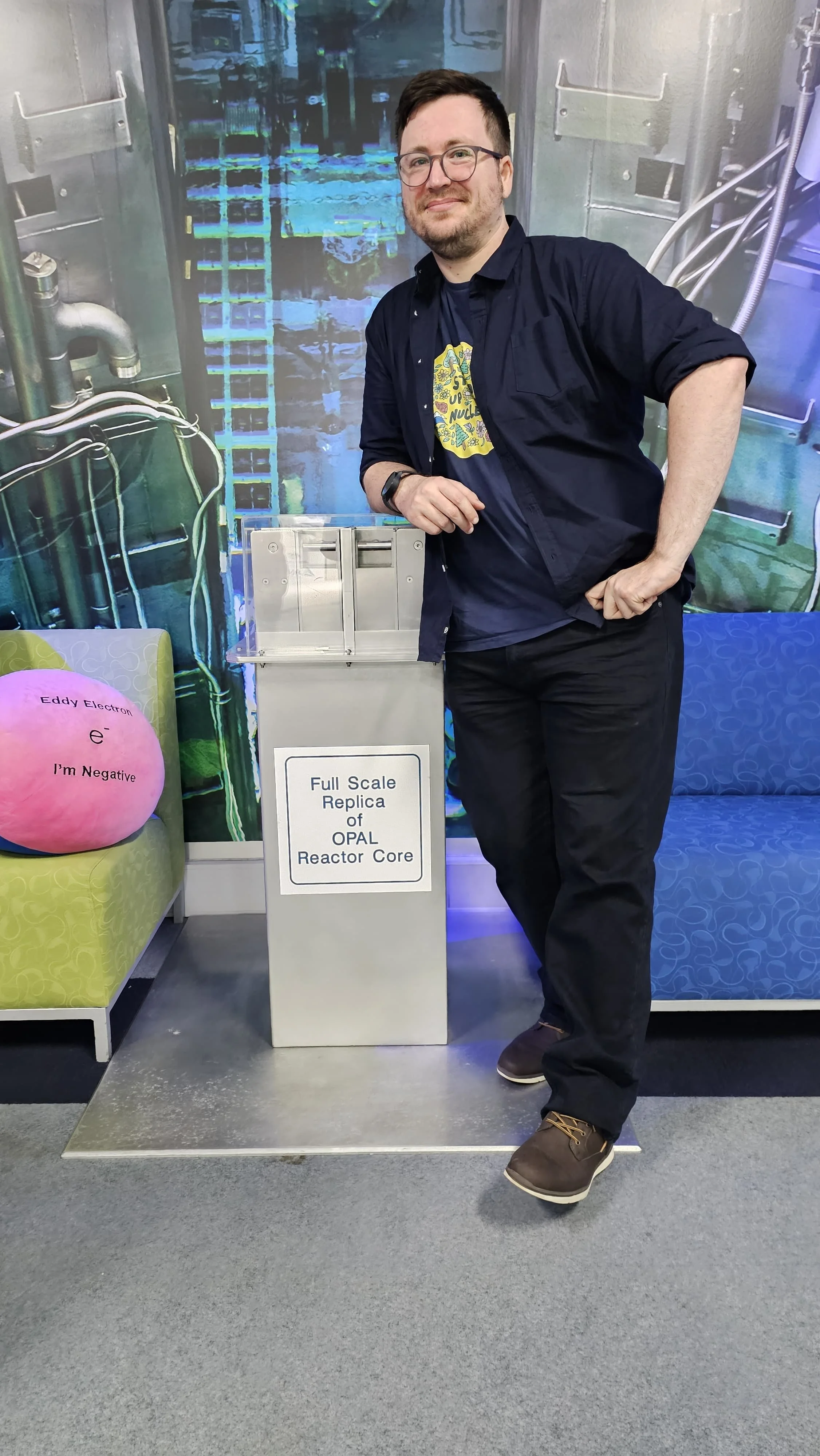
D’Lisle posing in front of a full scale replica of a reactor core.
WePlanet Australia, co-founded by D’Lisle is actively working with Nuclear for Australia to keep nuclear on the national agenda. D’Lisle believes the Green Party is more likely to switch positions on nuclear than the Labor Party. If such a switch happens, it will give political cover for the Labor Party to come out as pro-nuclear, D’Lisle said. At the moment, Labor fears a pro-nuclear stance will cause the party to lose voters on the left and in inner cities.
Moving forward, D’Lisle hopes to find ways to protect the environment and ensure people have a high standard of living. In addition to nuclear, D’Lilsle plans to advance precision fermentation and alternative proteins to reduce the environmental impacts of agriculture.
“I want to continue learning about solutions to climate change and biodiversity loss. To engage with the science and advocates around the world,” D’Lisle said. “To continue to grow and to show people what we’re fighting for, and hopefully have them come on this journey with us, so that we can influence public policy on key issues.”
Written by Jack Austin